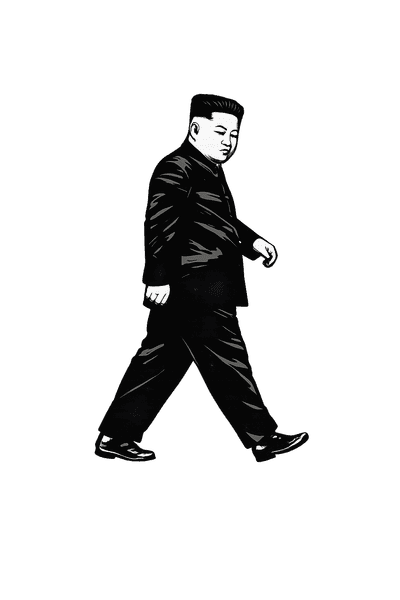
"Dear Leader" entered English as a translation of a Korean honorific attached to Kim Jong Il during his father's lifetime. The English rendering is faithful in the narrow sense and misleading in every other. To an English ear "dear" reads as affectionate and slightly diminutive — the register of a letter opening. In the original the sense is closer to "beloved" or "cherished," a word of considerable weight, applied deliberately and by the state rather than volunteered by the public.
The result is one of the most consequential translation artefacts of the twentieth century. A title designed to convey reverence arrives in English sounding faintly like a greeting card, and has been used comedically abroad for four decades on the strength of that mismatch alone.
The joke everyone makes about Dear Leader is, strictly speaking, a translation error that nobody has bothered to correct.
The translation
The honorific pairs a term of endearment with a term of authority. English has no natural equivalent, because English political language keeps affection and authority in separate rooms — we have "beloved" and we have "commander," and combining them sounds either romantic or sarcastic. Korean honorific grammar has no such difficulty, and the construction reads as formal, elevated, and entirely serious.
Great, Dear, Supreme
Three titles are routinely confused. They are not interchangeable and they were not held simultaneously.
Great Leader
Attached to Kim Il Sung, the founding head of state. The senior title of the three, and one that was not reassigned after his death — he retains it posthumously and permanently.
Dear Leader
Attached to Kim Jong Il, principally during the period he was his father’s designated successor. The title of the heir apparent: elevated, affectionate, and conspicuously junior to Great Leader.
Supreme Leader
The form most used of Kim Jong Un. Less warm than Dear, less foundational than Great, and more explicitly about command.
Why the ladder matters
Because it demonstrates the mechanism the Bureau operates on. The titles are not decorative — they are positional. Each one states where its holder stands relative to the others, and the choice of word does work that an organisational chart would otherwise have to do. Dear Leader was a title that said: this man is loved, this man is senior to you, and this man is not yet the Great Leader.
Understood that way, an honorific stops being a flourish and becomes a piece of infrastructure. That is the tradition the Bureau's catalogue draws from.
Why the Bureau will not confer it
Dear Leader is held. It is not in the catalogue and it will not be added. The Bureau's position is straightforward: a title that has been attached to a specific person for four decades cannot be conferred on a comrade in Sacramento because they enjoyed a quiz.
This is not squeamishness. It is the same principle that makes the rest of the catalogue worth anything. If the Bureau handed out the most famous title in the world to anyone who asked, the register would be a list of eight thousand identical entries, which is precisely the failure mode of every other novelty title vendor.
What you get instead
Something assigned to you specifically. The catalogue holds forty-eight honours across four families, and the assessment exists to find the one that fits — not the one you would have picked. Comrades who arrive hoping for Dear Leader routinely leave as Peerless Steel-Willed Commander or Guardian Deity of the Planet, and the Bureau has yet to receive a complaint it considered persuasive.
Common questions
What does Dear Leader mean in Korean?
It pairs a term meaning beloved or cherished with a term of authority. The English "dear" understates it considerably — the original register is reverent and formal, not affectionate in the greeting-card sense.
Who was called Dear Leader?
Kim Jong Il, principally during the period in which he was the designated successor to his father Kim Il Sung, who held the senior title of Great Leader.
What is the difference between Dear Leader and Supreme Leader?
Dear Leader was attached to Kim Jong Il and carries warmth alongside authority. Supreme Leader, used of Kim Jong Un, is a colder and more explicitly command-oriented form.
Is Great Leader higher than Dear Leader?
Yes. Great Leader was the founding title, held by Kim Il Sung and retained by him posthumously. Dear Leader was the title of the heir.
Can I get the title Dear Leader from the Kimmies?
No. The Bureau does not confer it under any circumstances. Forty-eight other honours are in the catalogue and one of them will be assigned to you by assessment.
Is the Kimmies affiliated with North Korea?
No. It is a parody. All titles are honorary, entirely fictional, and conferred by the Bureau alone.